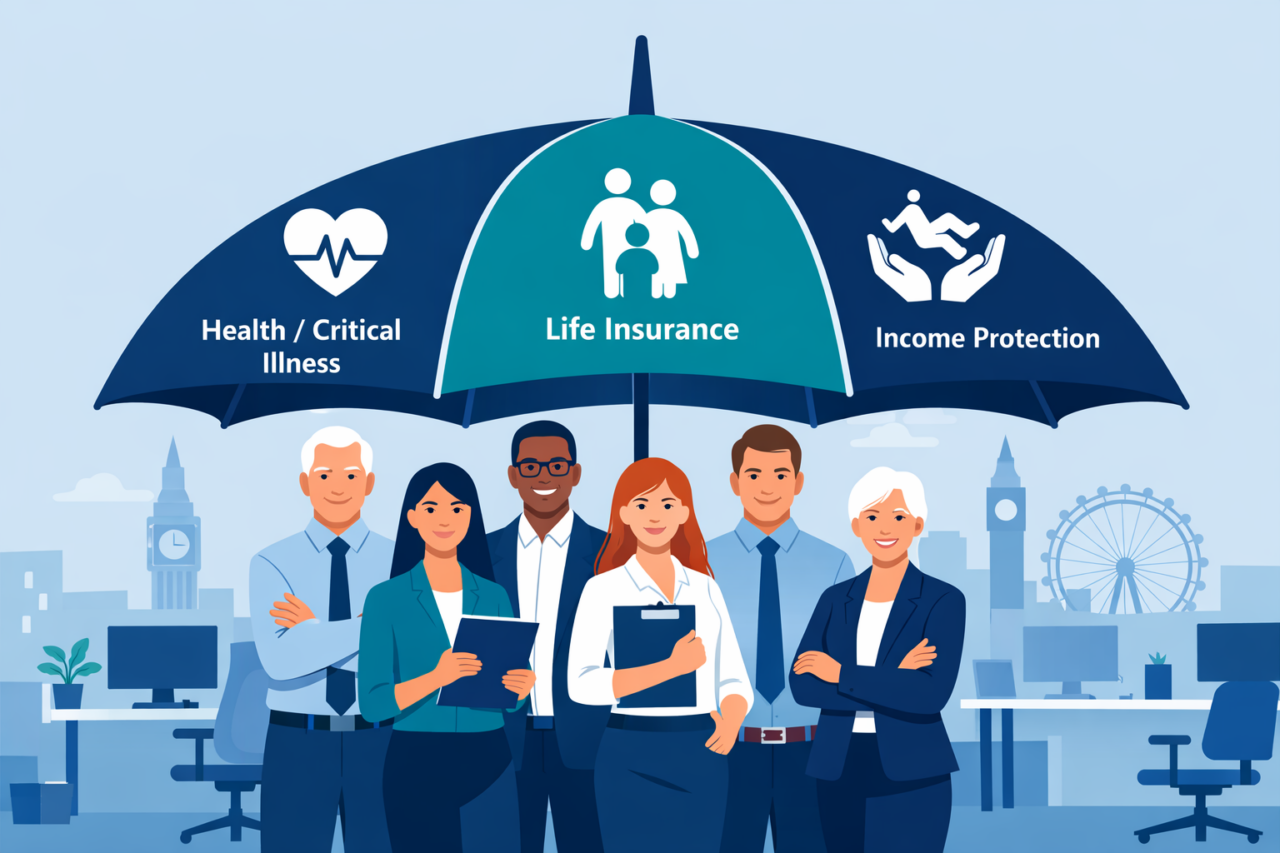
Group risk insurance is a collective financial protection scheme that UK employers provide to safeguard their employees against serious life events like death, critical illness, or long-term inability to work. Unlike individual insurance policies that employees purchase themselves, group risk insurance is arranged by the employer and typically covers the entire workforce or specific employee groups under a single master policy.
In the UK, approximately 12 million employees currently benefit from some form of group risk coverage, according to the Association of British Insurers. These workplace protection benefits have become increasingly important as employers recognize their role in providing financial security beyond salary and standard benefits.
This guide explains exactly what group risk insurance covers, who needs it, and how it works in practice for UK employers and employees.
What Is Group Risk Insurance?
Group risk insurance is employer-sponsored financial protection that provides lump sum payments or ongoing income replacement when employees face serious health events or death. The "group" element means coverage is provided collectively rather than individually, which typically makes it more affordable and accessible than personal insurance policies.
According to the ABI's definition of group insurance, these schemes are designed to cover employees as a collective group under a single master policy, with the employer typically paying all or most of the premium costs.
The Three Core Components
Group risk insurance typically includes three main types of coverage:
Group Life Insurance provides a lump sum payment to an employee's beneficiaries if they die while employed. The standard payment is typically 4 times annual salary, though this can range from 1x to 10x depending on the employer's policy. In 2024, the average payout under UK group life policies was approximately £180,000, according to Legal & General's group protection claims data.
Group Income Protection replaces a portion of an employee's salary (usually 50-75%) if they become unable to work due to illness or injury for an extended period. Unlike statutory sick pay, which maxes out at £116.75 per week for 28 weeks, group income protection can continue until the employee recovers, reaches retirement age, or the policy term ends.
Group Critical Illness Cover pays a lump sum if an employee is diagnosed with a specified serious condition such as cancer, heart attack, or stroke. The typical payment is 2-4 times annual salary. According to the ABI, cancer claims represent approximately 60% of all critical illness claims under group policies.
What Does Group Risk Insurance Cover in the UK?
Covered Events and Conditions
Group risk insurance policies cover specific, clearly defined circumstances:
Death in Service (Group Life Insurance)
- Death from any cause while employed
- Death within 12 months of leaving employment (terminal illness extension)
- Payment to nominated beneficiaries or estate
- No medical underwriting required for standard schemes
Long-Term Illness or Injury (Group Income Protection)
- Physical illnesses preventing work (musculoskeletal conditions, cancer, cardiovascular disease)
- Mental health conditions (depression, anxiety, stress-related disorders)
- Accidents causing disability
- Typically requires a deferred period (4-26 weeks) before payments begin
- Continues until recovery, retirement, or policy term end
According to CIPD research on employee benefits, musculoskeletal conditions and mental health issues together account for over 70% of long-term absence claims under group income protection policies.
Serious Medical Diagnoses (Group Critical Illness)
- Cancer (excluding early-stage and specific types)
- Heart attack (severity criteria apply)
- Stroke (resulting in permanent symptoms)
- Kidney failure requiring dialysis
- Major organ transplant
- Multiple sclerosis
- Paralysis
- Coronary artery bypass surgery
Most UK group critical illness policies cover 40-50 conditions, though the exact list varies by insurer. Legal & General reports that the top three claimed conditions are cancer (60%), heart attack (15%), and stroke (12%).
What's Not Typically Covered
Understanding exclusions is equally important:
- Pre-existing conditions (may be excluded or subject to medical underwriting for new joiners)
- Self-inflicted injuries
- Criminal activities
- Short-term absence (covered by employer sick pay or statutory sick pay instead)
- Conditions arising from alcohol or drug abuse (some policies)
- Suicide within the first 12-24 months (death in service policies)
Is Group Risk Insurance the Same as Group Protection?
Yes, the terms are used interchangeably in the UK insurance market. "Group risk insurance" and "group protection insurance" both refer to the same employer-sponsored financial protection benefits covering employees against serious health events and death.
As explained by Aviva's group protection overview, some providers prefer "group protection" because it emphasizes the protective nature of the coverage rather than the risk element. However, industry publications, insurers, and professional bodies like CIPD use both terms to mean exactly the same thing.
The key distinction to understand is between "group risk/protection" (employer-sponsored collective coverage) and "individual protection" (personal policies purchased directly by individuals).
Is Group Risk Insurance Worth It for Employers?
The Business Case
Group risk insurance delivers measurable value beyond the moral argument of protecting employees:
Employee Attraction and Retention: According to Corporate Adviser's group risk market research, 78% of employees consider group risk benefits important when evaluating job offers. The same research found that 64% of employees would be less likely to leave an employer offering comprehensive group protection.
Productivity Protection: Group income protection policies typically include rehabilitation support services. Corporate Adviser reports that employees who receive early intervention and rehabilitation support return to work 40% faster than those without such assistance.
Cost Efficiency: Group policies are significantly cheaper than equivalent individual coverage. A 35-year-old employee might pay £30-40 per month for individual income protection with a 26-week deferred period. The same coverage under a group scheme typically costs employers £10-15 per employee monthly.
Tax Advantages: Group life insurance premiums are tax-deductible business expenses, and for employees, the benefit-in-kind tax is minimal (calculated on the notional cost of provision, often just a few pounds monthly).
Typical Cost Ranges
Based on 2024 market data from industry benchmarking:
- Group Life Insurance: £5-15 per employee per month (4x salary coverage)
- Group Income Protection: £15-40 per employee per month (varies significantly with deferred period and coverage level)
- Group Critical Illness: £8-20 per employee per month (3x salary lump sum)
A comprehensive group risk package for a 100-employee company typically costs £2,500-4,500 monthly (£25-45 per employee), though this varies considerably based on industry risk profile, employee demographics, and coverage levels.
Is Group Risk Insurance Mandatory in the UK?
No, group risk insurance is not legally required for UK employers. Unlike workplace pensions (mandatory under auto-enrolment legislation) or employers' liability insurance (legally required), group risk benefits are entirely voluntary.
However, as the CIPD's employee benefits factsheet notes, certain circumstances create strong incentives or expectations:
Industry Norms: In sectors like financial services, professional services, and technology, comprehensive group risk benefits have become standard. Not offering them can put employers at a competitive disadvantage for talent.
Employee Contracts: If employment contracts specifically promise death in service benefits or income protection, the employer has a contractual obligation to provide these benefits.
Trade Union Agreements: Some collective bargaining agreements include group risk benefits as negotiated terms.
Succession Planning: For key person insurance purposes, many businesses use group life or critical illness cover to protect against the financial impact of losing essential employees.
According to Mercer's employer benefits benchmarking data, 85% of employers with 250+ employees offer group life insurance, while 64% offer group income protection. Among smaller employers (50-249 employees), these figures drop to 62% and 38% respectively.
Which Employers Typically Offer Group Risk Benefits?
By Company Size
Large Employers (500+ employees): Nearly universal provision
- 90%+ offer group life insurance
- 75%+ offer group income protection
- 50%+ offer group critical illness cover
Medium Employers (50-499 employees): Common but not universal
- 65% offer group life insurance
- 40% offer group income protection
- 25% offer group critical illness cover
Small Employers (under 50 employees): Less common
- 35% offer group life insurance
- 15% offer group income protection
- 10% offer group critical illness cover
By Sector
According to CIPD's 2024 Benefits Survey, these sectors show the highest adoption rates:
- Financial Services: 92% offer comprehensive group risk packages
- Professional Services (legal, accounting, consulting): 88% offer group life and income protection
- Technology: 82% offer competitive group risk benefits
- Pharmaceuticals and Healthcare: 78% offer group protection
- Public Sector: 75% offer group benefits (though coverage levels vary)
Manufacturing, retail, and hospitality sectors show lower adoption rates (35-55%), often due to tighter margins and different workforce demographics.
How Much Does Group Risk Insurance Cost?
Cost Factors
The premium for group risk insurance varies based on:
Workforce Demographics
- Average age (older workforces cost more)
- Gender mix (affects pricing, particularly for income protection)
- Occupational risk (office workers vs. manual workers)
- Geographic location (regional health variations)
Policy Design
- Salary multiples (higher death in service multiples increase premiums)
- Deferred periods (shorter deferred periods on income protection mean higher premiums)
- Definition of incapacity (own occupation vs. any occupation)
- Benefit escalation (inflation-linked benefits cost more)
Claims Experience
- Employer's past claims history
- Industry benchmark claims rates
- Policy structure (self-insured elements vs. fully insured)
Real-World Example
For a professional services firm with 50 employees:
- Average age: 38
- Average salary: £45,000
- Office-based roles
Sample Premium Structure:
- Group Life (4x salary): £9.50 per employee/month = £475/month total
- Group Income Protection (75% salary, 26-week deferred): £28.00 per employee/month = £1,400/month total
- Group Critical Illness (3x salary): £14.50 per employee/month = £725/month total
Total package: £2,600/month or £31,200/annually (£52 per employee per month)
This represents approximately 1.4% of the total salary bill, which is consistent with industry benchmarks of 1-2% of payroll for comprehensive group risk coverage.
What Types of Benefits Are Included in Group Risk?
Standard Inclusions
Beyond the core financial protection, modern group risk policies include valuable additional services, as detailed in Legal & General's workplace protection resources:
Rehabilitation and Absence Management
- Early intervention services (physiotherapy, cognitive behavioral therapy access)
- Occupational health assessments
- Return-to-work planning
- Workplace adjustments advice
Canada Life's 2023 claims data shows that claimants who engaged with rehabilitation services returned to work an average of 12 weeks earlier than those who didn't.
Employee Assistance Programs (EAPs)
- 24/7 confidential counseling helpline
- Legal and financial guidance
- Wellbeing resources
- Mental health support
Second Medical Opinion Services
- Expert medical consultations for serious diagnoses
- Treatment pathway advice
- Access to specialist networks
Health Screening and Prevention
- Annual health assessments for senior employees
- Mental health check-ins
- Lifestyle and wellbeing resources
Optional Enhancements
Employers can typically add:
- Flexible benefits: Allowing employees to buy up or down on coverage levels
- Dependent life cover: Extending death benefits to employees' families
- Salary continuance: Bridging gaps between statutory sick pay and group income protection
- Redundancy cover: Providing income protection if made redundant
What's the Difference Between Group Risk and Employee Benefits?
Group risk insurance is a subset of employee benefits, not a separate category. As explained in the CIPD's employee benefits framework, the relationship works like this:
Total Rewards Package includes:
- Monetary compensation (salary, bonuses)
- Employee benefits (the comprehensive package), which includes:
- Mandatory benefits (workplace pension, statutory sick pay)
- Health benefits (private medical insurance, dental, vision)
- Lifestyle benefits (gym memberships, cycle to work schemes)
- Group risk insurance (the financial protection element)
- Leave and flexibility (holiday, flexible working)
Group risk insurance specifically refers to the financial protection components (life insurance, income protection, critical illness cover) that protect against serious life events. These sit within the broader employee benefits package.
According to industry benchmarking, the average UK employer offering group risk benefits allocates 30-35% of their total benefits budget to these protection elements, with the remainder covering health benefits, lifestyle perks, and flexible benefits.
Group risk insurance provides essential financial protection that most UK employees cannot replicate affordably through individual policies. For employers, these benefits deliver measurable returns through improved recruitment, retention, and productivity, while costing approximately 1-2% of payroll.
The three core components—group life insurance, group income protection, and group critical illness cover—each address specific financial risks that could devastate employees and their families. With 78% of employees considering these benefits important when evaluating job offers, they've evolved from optional perks to competitive necessities in many sectors, as evidenced by Corporate Adviser's ongoing market analysis.
While not legally required, group risk insurance has become standard practice among medium and large UK employers, particularly in professional services, financial services, and technology sectors. The collective purchasing power of group schemes makes comprehensive protection accessible at a fraction of individual policy costs.
For employers considering group risk insurance: Start by benchmarking what competitors in your sector offer using resources like Mercer's benefits research, then design a package that aligns with your budget while meeting employee expectations. Most insurers and brokers provide free consultation and quote services.
For employees wondering about coverage: Check your employee handbook or speak with HR to understand exactly what protection your employer provides. If your company doesn't offer group risk benefits, consider whether individual income protection or life insurance makes sense for your circumstances.
Frequently Asked Questions
What is group risk insurance?
Group risk insurance is employer-sponsored financial protection that provides lump sum payments or ongoing income replacement to employees affected by death, critical illness, or long-term inability to work. It's arranged collectively for groups of employees rather than individually, making it more affordable and accessible than personal insurance.
What types of benefits are included in group risk?
The three main types are: group life insurance (lump sum on death), group income protection (salary replacement during long-term illness), and group critical illness cover (lump sum on diagnosis of serious conditions like cancer or heart attack). Most policies also include rehabilitation support, employee assistance programs, and wellbeing resources.
Is group risk insurance the same as group protection?
Yes, these terms are used interchangeably in the UK market. Both refer to the same employer-sponsored collective insurance arrangements covering employees against serious health events and death.
Is group risk insurance mandatory in the UK?
No, group risk insurance is entirely voluntary for UK employers, unlike workplace pensions or employers' liability insurance which are legally required. However, it has become standard practice in many sectors, particularly among larger employers and in industries competing for professional talent.
How much does group risk insurance cost?
Costs typically range from £25-60 per employee per month for comprehensive coverage, depending on workforce demographics, coverage levels, and industry risk. This represents approximately 1-2% of total payroll. Group life insurance alone costs £5-15 per employee monthly, while income protection costs £15-40 per employee monthly.
Which employers typically offer group risk benefits?
Larger employers are most likely to offer group risk insurance, with 90%+ of companies with 500+ employees providing at least group life insurance. Adoption is highest in financial services (92%), professional services (88%), and technology (82%) sectors. Smaller employers and those in retail, hospitality, and manufacturing sectors show lower adoption rates.
Not sure which fits your team?
Get a free employee benefits review — 30 minutes, independent, no obligation. We'll look at headcount, budget and current benefits, and tell you honestly whether a cash plan, PMI, or neither is your right next move.